Logistics and Freight Forwarders
At a logistics center, the staff exit, driver access, and goods receiving decide shrinkage and security. Learn what to settle before you buy, how to lay out screening for shift change, and what day-to-day operation involves.

A logistics center runs three checkpoints. The staff exit deals with shrinkage, the visitor and driver entrance with outsiders, and goods receiving with suspicious shipments. Each needs its own procedure.
Immediate initial consultation
We look forward to hearing from you and are glad to prepare an individual quote. We serve customers in Germany, Austria and Switzerland.
Send requestPlanning theft prevention at a logistics center
Start with your own losses. Where does stock vanish, on which shift? Theft from warehouses and transshipment points is among the most common forms of cargo crime, and only part of it gets reported. Industry figures therefore say little about your warehouse. For your site, a one- to two-month pilot supplies the numbers. We measure shrinkage for 30 days beforehand as a baseline, run the checkpoint, and evaluate. If you have a works council, involve it early. We bring a template works agreement.
Bag checks and the works council
Gate and bag checks govern employee conduct on site. If you have a works council, it therefore has a say under Section 87(1) No. 1 BetrVG. If the system records data tied to individuals, No. 6 may apply too. The labor courts require checks to stay proportionate. A random selection, a screened inspection room, and graduated intensity have proven themselves. Employees then empty everything only on concrete suspicion. Put exactly these points in your agreement. The law depends on the case, so settle your rules with the works council and counsel. More on exit screening under theft prevention.
Employee screening at the staff exit
At the staff exit, workflow decides throughput. Personal bags stay in lockers before the checkpoint. Written rules for backpacks in the warehouse are part of common security standards anyway. Anything else goes on an inspection table. Phones and keys go in a tray. A traffic light clears the next person. Who goes to secondary screening? A random sample decides, not a guard's gut feeling. Pick a program matched to your goods and filter out gum wrappers. Higher levels catch more steel tools but slow the flow. Employees with a pacemaker or defibrillator show their device card and can request a hand-wand check.
The Garrett PD 6500i counts people and alarms both ways and adds random alarms from 0 to 50 percent. That builds the random sample into the device. Its 33 zones show where on the body metal sits. We tune multiple units across 2,300 frequencies, and with professional installation they stand 5 cm apart. The Garrett Paragon narrows the location down to 66 zones and shows its status on an OLED display. The Garrett Guide handles targeted secondary checks, up to 125 hours per charge.
Lanes and layout for shift change
At shift change, everyone comes at once. If 2,700 employees leave within 30 minutes, the checkpoint must handle about 5,400 people an hour. At about 900 per lane per hour, that means six walk-through detectors side by side, each frequency-tuned. Routes first. Then devices. Lockers, time clocks, and checkpoint sit in one line so nobody doubles back. Conveyors, Wi-Fi, radios, and cables in walls interfere with detection. We map them during the site survey and plan your security checkpoint.
Visitor and driver access
For visitors, government photo ID, a visitor log, and an escort by your own staff have proven themselves. Common logistics security standards require exactly that. Check drivers' ID and license, and record the vehicle's plate and type. Have visitors show ID. Copying or photographing it needs its own legal basis under the GDPR. Keep the log on paper or in software. A driver lounge with its own entrance keeps drivers out of the warehouse. Only people who work at the dock get in.
Goods receiving and suspicious shipments
Goods receiving takes in shipments with unknown contents. An X-ray image reveals them without opening the box. That helps with damaged packages and dubious returns. Place the scanner where packages already move from truck to inspection zone. Lithium batteries count as dangerous goods. Under ADR special provision 188, lithium-ion batteries up to 100 watt-hours can ship with relaxed rules. Damaged batteries fall under stricter rules. X-ray does not replace a dangerous goods check. The comparison of all X-ray scanners shows which unit fits your consignments. It shows where to look closer.
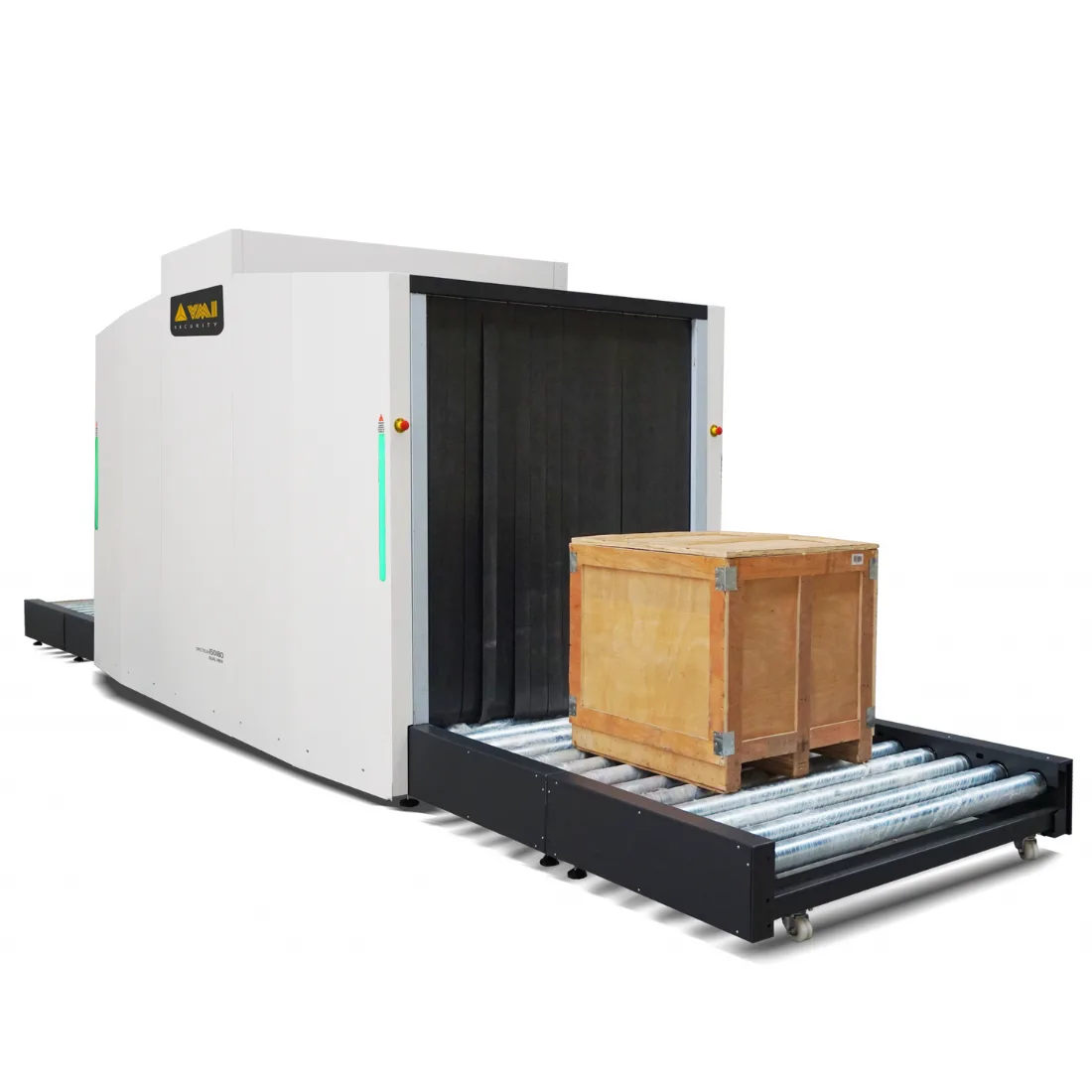
The VMI Spectrum 6040 screens parcels and containers in a tunnel of 62,0 x 42,4 cm. For bulky items, the Spectrum 100100 DV offers 101,4 x 101,0 cm and shows every package from two angles. The Spectrum 150180 scans entire pallets through a 162,6 x 180,0 cm tunnel with a conveyor load of 3000 kilograms. Compare more under X-ray scanners for mail and parcels.
For air cargo and large freight installations, continue to X-ray scanners for freight.
TAPA, AEO, and ISO 28000
Shippers and logistics providers write security standards such as TAPA FSR into their agreements. These require controlled access at the staff entrance and documented procedures for exit searches, where local law allows them. As an Authorized Economic Operator (AEO), you protect shipping and loading areas from unauthorized access. ISO 28000 frames security management across the supply chain. None prescribes a specific device. They require documented procedures.
Maintenance and day-to-day operation
Test the detectors regularly with a test object. We recommend maintenance every two years for walk-through detectors and yearly for X-ray scanners. If a unit fails, we provide a loaner. When seasonal staff start, we refresh operator training. Watch for three common mistakes. Bags go through the frame instead of across the table, a new conveyor sits too close to the checkpoint, or the random sample drifts from the agreement. When procedures change, update the works agreement.
Frequently asked questions
Does TAPA require metal detectors?
The standard requires procedures for entry and exit, not a specific technology. That choice is yours.
Can we rent equipment for peak season?
Metal detectors and the VMI Spectrum 6040 and 6040 C X-ray scanners are available to rent. For the holiday peak, contact us in August. We deliver two to four weeks before it starts. See renting X-ray scanners.
What applies to operating an X-ray scanner?
Operation falls under radiation protection law. Your operator obligations and the steps we handle are covered under radiation protection and operator obligations.
Call us directly
or send us your enquiry.
Free and without obligation. We advise on the right technology for your use case.
Monday to Friday, 8 am to 5 pm. Replies to enquiries within 24 hours.