Courts
You are planning a security checkpoint for your court, or you already run one. Here you can read what to settle before planning, how to lay out the entrance and what matters in daily operation.

Visitors, witnesses, lawyers and staff all meet at the courthouse entrance. A security checkpoint is there to find weapons and dangerous items before anyone reaches the courtroom. It must not block the way to a public hearing. This page takes you from the first question to daily operation.
Immediate initial consultation
We look forward to hearing from you and are glad to prepare an individual quote. We serve customers in Germany, Austria and Switzerland.
Send requestMay a court screen at the entrance, and does it have to?
At the building entrance, the court’s management holds the right to control access to the premises. In the courtroom, the presiding judge decides. The presiding judge is responsible for order in the hearing. Both powers are limited by the principle of public hearings. Screening is compatible with it as long as it makes access only slightly more difficult.
There is no nationwide obligation in Germany. Each federal state regulates the security of its own courts. Many states now screen at all of their courts. What applies to your court is set by your state justice administration.
Five questions before planning
A security checkpoint is not designed at a desk. We work through these points with you before we recommend a device.
- How many visitors come per day, and when are the peaks before hearings?
- What should screening find? Knives and firearms call for a different setting than very small metal parts.
- What does the entrance look like? Door width, stairs, floor load and power connection determine layout and devices.
- Which sources of interference are nearby? Elevators, switch cabinets, radios and automatic doors affect the metal detector.
- Who operates the checkpoint? A single gatekeeper needs a different solution than a team of court officers.
The higher you set the security level, the more alarms your staff have to resolve, and the slower entry runs. You define this trade-off in your security concept.
How to lay out the checkpoint at the courthouse entrance
The sequence is always the same. Visitors place keys and phone in a tray and their bag on the belt of the X-ray scanner. Then they walk through the detector. If it signals metal, your staff follow up with the hand-held metal detector. At the end of the belt, visitors pick up their belongings again.
Do not place the detector directly in the doorway. Otherwise the line backs up onto the street in the rain, and unscreened people stand close to the checkpoint. A screening area behind the entrance with room for trays and secondary screening works better. The walk-through detectors are 0.76 meters wide. For wheelchairs and strollers, plan a path next to the frame where your staff screen by hand.
Which walk-through detector fits a court?
A court has no rush like a stadium. Visitors arrive spread over the day. In the courthouse program, around 850 people per hour pass one detector. For a court with 1,200 visitors per day, a single unit is therefore enough. The calculation is shown in the worked example at the end of this page.
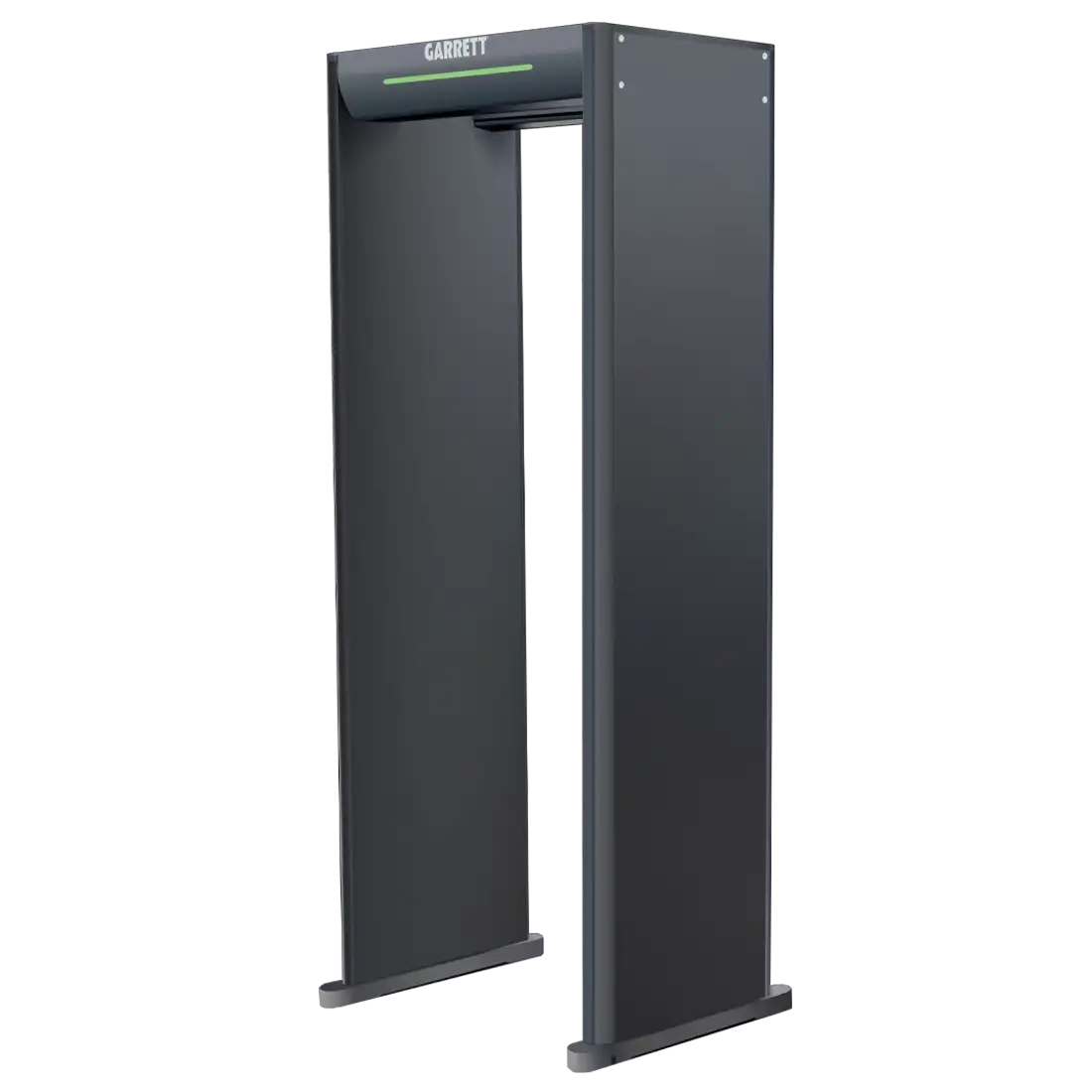
The Garrett PD 6500i pinpoints metal in 33 zones and comes with 20 preconfigured programs. The Garrett Paragon shows the location in 66 zones. Your staff see where to follow up. Both units count passages. For secondary screening there is the Garrett Guide hand-held metal detector.
X-ray scanners at court for bags and briefcases
The X-ray scanner shows your staff the contents of bags, backpacks and briefcases on the monitor. In most cases, nothing has to be unpacked by hand. The VMI Spectrum 6040 has a tunnel of 62,0 x 42,4 centimeters. Short on space in the lobby? The VMI Spectrum 6040 C fits through doors from 80 centimeters wide and has a folding conveyor.
Plan floor load and the delivery route early. The two scanners weigh around 435 and 495 kilograms. The comparison of all X-ray scanners shows every size.
Staff and daily operation
Often a single gatekeeper staffs the entrance. A walk-through detector with remote control and display helps. The gatekeeper stays in place and sees every alarm from there. If you add an X-ray scanner, plan a second person for image evaluation.
Screening only works as long as the settings are right. This routine has proven itself.
- Check the settings at the start of duty and at shift change.
- Record passage and alarm counts continuously.
- Refresh staff training regularly.
- Define how you treat lawyers, court staff and visitors with an official ID.
- Offer visitors with a pacemaker a manual check on request.
Fixed office hours and appointments also spread out the load at the checkpoint.
Operator duties for the X-ray scanner at court
With the X-ray scanner, your court becomes the operator of an X-ray installation. You notify the competent authority in writing of a type-approved unit no later than two weeks before the planned start. Which documents are required depends on the unit’s type approval. An officially appointed expert inspects every X-ray installation at least every five years. You instruct your operators before first use and every year after that.
We state the approval status of your unit in the quote and support you with the notification and inspection dates. Read more under operator duties and radiation protection. This page does not replace legal advice.
Buy or rent, and how long it takes
Both routes are open to you. When you buy, we plan with you, deliver, put the devices into operation and train your staff. Rental runs for 3 to 36 months, with maintenance and insurance included in the monthly rate. A rented checkpoint is ready for use in two to four weeks. That also suits a single trial with increased protection needs or bridging during a renovation. The terms are listed under rental for public authorities and justice.
How we approach planning is shown under planning security checkpoints. Describe your entrance to us via the contact form.
Frequent questions about entrance screening at court
Is entrance screening mandatory at German courts?
There is no nationwide obligation. Each federal state regulates the security of its courts itself. Ask your state justice administration about the rules for your court.
How many devices does a local court need?
In our example with 1,200 visitors per day, one walk-through detector, one hand-held metal detector and one X-ray scanner are enough. We plan the number for your court based on your visitor figures.
May visitors with a pacemaker walk through the detector?
Walking through at a normal pace is considered harmless. Still, define how your staff screen visitors with an implant card by hand on request.
Does a court need a radiation protection officer for the X-ray scanner?
That depends on the unit’s type approval. For a fully shielded unit, the law only requires the approval certificate and proof of quality control. For other device classes you also provide proof of expertise. If in doubt, ask your competent authority.
One device for the court entrance
A worked example for the steady entrance screening of a court.
The maths at the court entrance
A court with 1,200 visitors across the day has no peak rush like a stadium but a steady stream. Over eight opening hours, the Courthouse program at around 850 people per hour makes a single walk-through detector enough, complemented by the hand-held detector for the secondary check.
A second device brings no gain here, because the crowd spreads across the day and the queue at a single device never becomes critical. The real work lies in the setting. The court defines what may pass, and the detector separates exactly at that line between everyday item and dangerous metal. Only this fine-tuning turns a walk-through into a dependable check.
For the permanent setup you choose the Paragon, to buy or on monthly rental. On request we handle the site survey, setup and the instruction of the reception service.
Have your access plannedCourt entrance
Example scenario. The number of devices follows the throughput model and is planned for your site.
Call us directly
or send us your enquiry.
Free and without obligation. We advise on the right technology for your use case.
Monday to Friday, 8 am to 5 pm. Replies to enquiries within 24 hours.