Walk-through detector
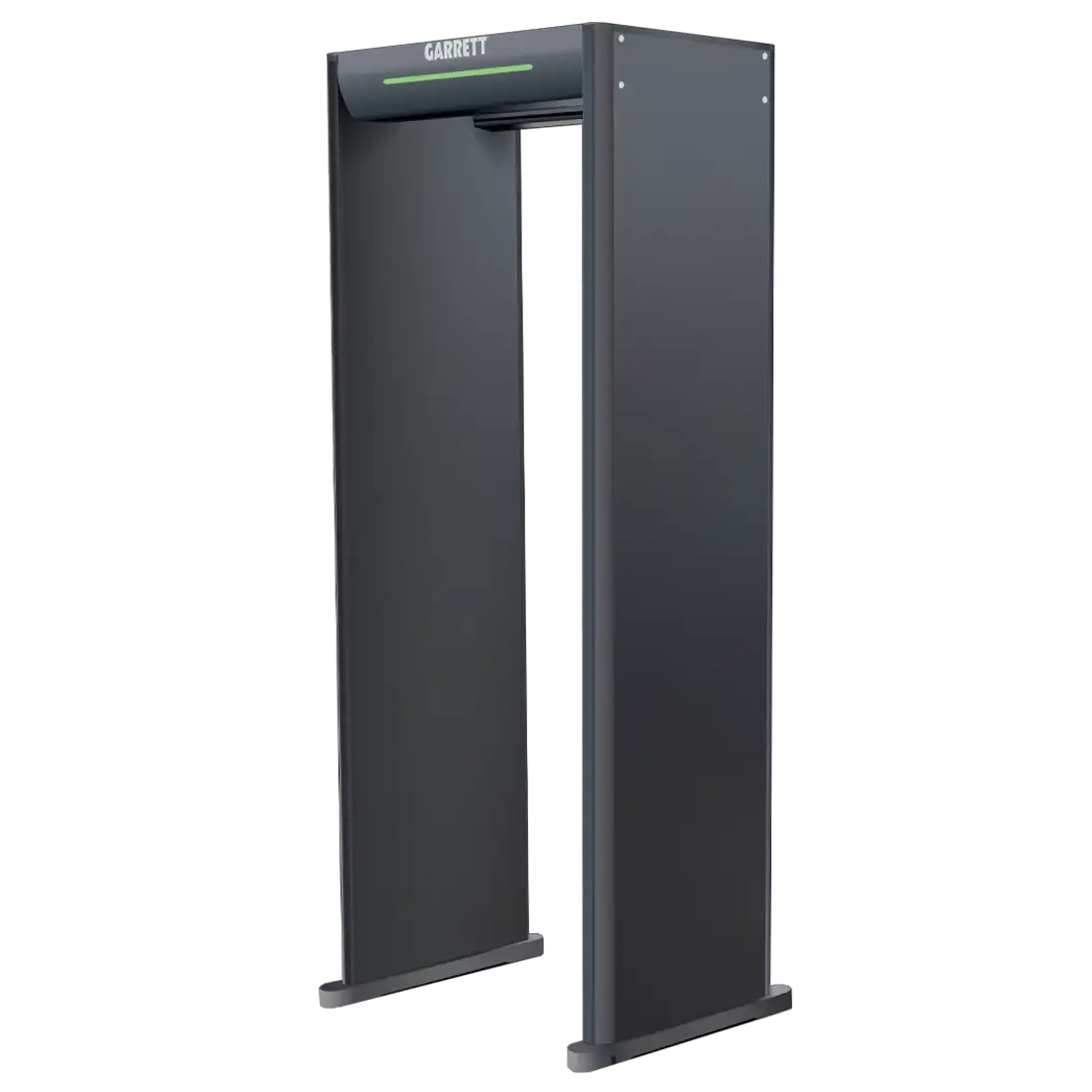
Walk-through detectors screen many people in a short time. In the security lane they handle the primary check, and the precise secondary check is then done by the hand-held detector. What matters is zone resolution, program selection and a location free of interference.

Walk-through detectors, also called archway detectors, screen many people in a short time. In the security lane they handle the primary check and regulate the flow, and the precise secondary check follows with the hand-held detector. Their place is everywhere high visitor volumes meet a fixed security level. That applies at airports, in correctional facilities, at large events or at the staff exit of a logistics centre.
Immediate initial consultation
We look forward to hearing from you and are glad to prepare an individual quote. We serve customers in Germany, Austria and Switzerland.
Send requestHow it works
Walk-through metal detectors work with electromagnetic induction. A field builds up inside the frame, and every person who passes through crosses it. Metal changes the field, receiver coils pick up the disturbance and output it as an audible and visual signal. The technology distinguishes types of metal and can be set so that it ignores everyday items such as jewellery or coins and does not slow the flow.
Through the program selection you adjust the sensitivity to the case at hand. Higher sensitivity detects smaller objects but produces more alarms and lowers throughput. The Garrett PD 6500i divides the walk-through field into 33 zones and comes with more than 20 preconfigured programs, from airport to correctional service. The Garrett Paragon resolves more finely with 66 zones and 200 sensitivity levels and discriminates even mini phones.

Both devices meet the US test standard NIJ 0601.02 for walk-through detectors and carry the approvals of international aviation, including TSA, ECAC, STAC, AENA and DfT.
Other important aspects
- Walk-through detectors are ready to use immediately, they do not have to be booted up first, and are maintenance-free in everyday use. We recommend a maintenance check every two years.
- The Garrett devices work with microprocessors, run a continuous self-test during operation and can be connected to the network for remote monitoring and control.
- Very small metal objects and non-metallic dangerous items such as ceramic knives are not detected by a walk-through detector for reasons of principle. Depending on the threat situation we therefore combine it with an X-ray scanner and a manual secondary check.
- Multi-level access tiers separate operator, supervisor and administrator and protect the settings against unauthorised access.
- Through an interface the device can be connected to cameras and other security components.
- The location decides smooth operation. Electrical switch cabinets, monitors, fire detectors or other detectors in the immediate vicinity can trigger false alarms and make a change of location necessary.
- Certificates confirm that the devices do not affect medical implants such as pacemakers. We nevertheless recommend that wearers walk through swiftly and centrally and, in case of doubt, choose a manual pat-down.
We are glad to advise you on selecting walk-through detectors and planning your security lane. On request we also handle installation, commissioning, maintenance and the training of your staff.
Call us directly
or send us your enquiry.
Free and without obligation. We advise on the right technology for your use case.
Monday to Friday, 8 am to 5 pm. Replies to enquiries within 24 hours.