How do entry controls raise event security?
Event security begins at the entrance, but it begins much earlier in the concept.
There is no one-size-fits-all solution for a safe event. Every event is assessed individually by size, location and audience. From this assessment comes a security concept that involves everyone concerned, right up to the municipality. Within it, entry control is the central, visible measure. Whoever intercepts dangerous objects here keeps them off the site.

The security concept
Before the technology comes the planning. A sound concept assesses the risks and derives the use of the detectors from them. These criteria are part of it:
- Expected number of visitors and available places (number of detectors)
- Visitor flow, possible bottlenecks and crush situations (placement locations)
- Number of security staff by visitor count and level of risk
- Audience profile (average age, expected behaviour)
- Number, marking and routing of the escape routes
- Need for crush barriers under sections 29 or 32 of the model assembly venues ordinance (Musterversammlungsstättenverordnung, MVStättVO)
- Fire hazards, fire safety and fire watches
- Number of paramedics and doctors
- Safety announcements and reachable managers during the event
- Parking organisation
Counting visitors
When capacity is limited, the people counter of the walk-through detector counts the people at the entrance. Together with the ticketing system you keep an eye on occupancy. It can be set to the counting direction, forward only, reverse only or as a subtraction of both directions. What matters is that throughput stays stable and the check per person stays short.

What the detector finds
Programmes such as spectator or building detect firearms, ammunition, striking and stabbing weapons, knives or pepper spray. They filter out harmless items such as coins, keys or foils. This keeps weapon detection accurate and low on alarms even at high throughput.
Traffic-light system and placement
With the go and wait symbols, the detector sets the pace. It only clears the next passage once the previous check is complete. The devices stand on level, stable ground, protected from rain and condensation, in a tent where needed. Distance lines in front of the frame order the approach. Crowd management additionally guides the visitor flows at narrow points and keeps the staff on the same level of information by radio.
How many security staff?
Usually a security service provides the staff for entry. How many are needed depends on the number of entrances and the types of check. As a rule of thumb, one to two people per checkpoint apply. Too few create queues, too many look disorganised, and the right number comes from the experience of comparable events.
Qualified staff
Reliable checks require experienced staff with a feel for people, who spot intoxicated individuals, aggressive groups or intentions to bring pyrotechnics early. For most guarding activities the 40-hour instruction at the IHK, the German chamber of industry and commerce, is enough (section 34a(1a) of the German trade regulation act (Gewerbeordnung, GewO), section 6 of the German guarding ordinance (Bewachungsverordnung, BewachV)). For certain tasks, such as running entry in a leading role at access-controlled major events, the IHK expert examination is mandatory. Since 2019 every guard has to be entered in the German guard register (Bewacherregister) (section 11b GewO). They wear a visible badge with a name or ID number and the name of the company. Alternative screening methods, such as the hand-held wand or the manual pat-down, expressly belong in the concept.
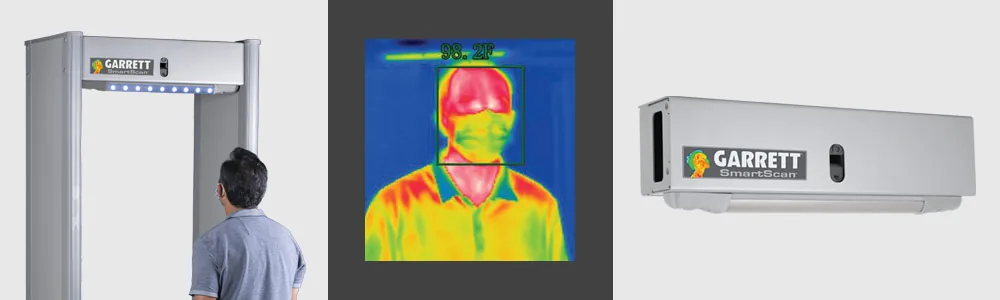
Optional: temperature screening
A SmartScan attachment measures body temperature without contact during the regular check, with no extra stop. In data protection terms, body temperature is health data under article 9 of the GDPR, the EU general data protection regulation. The most privacy-friendly interpretation stores no values and outputs only the traffic-light signal.
Practical example: Arena Oberhausen
The requirement for DTI
An additional person check for firearm, stabbing and cutting weapons in the entrance area.
The solution
In the ticket area, a security airlock of mobile walk-through detectors and manual access control. Final certainty comes from the follow-up check with the hand detector.
Practical example: TUI annual general meeting
The requirement for DTI
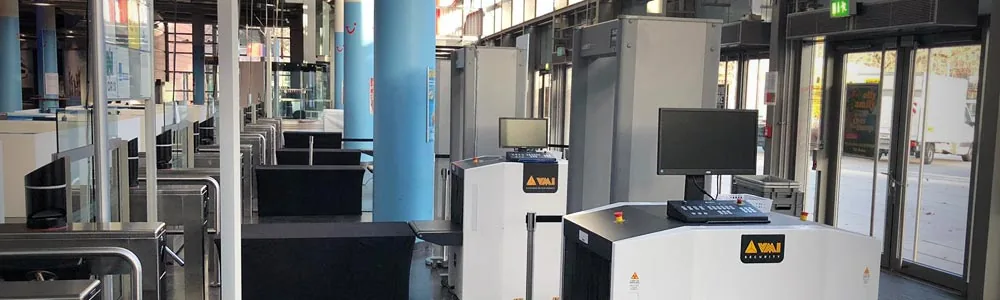
In front of the turnstiles, a person and baggage check for firearm, stabbing and cutting weapons, while the turnstiles check the access authorisation by ticket.
The solution
A security airlock of walk-through detectors and baggage scanner for hand luggage, complemented by the manual check. Final certainty comes from a look inside the luggage or the hand check with the Garrett Super Scanner V.
Suitable devices
Garrett PD 6500i Dual Optics. The microprocessor-controlled walk-through detector with pinpoint technology is designed for high throughput, tells ferrous from non-ferrous metal and comes with a people counter. The IP65 version is weatherproof and can be moved by one person on castors.
To the Garrett PD 6500i Dual Optics
To the Garrett PD 6500i IP65
Garrett SmartScan. The archway attachment for contactless temperature measurement, with no second checking step.
VMI Spectrum 6040 X-ray scanner. For events with hand luggage. Its 160 kV generator delivers the image quality needed, and the device is network-capable and can be coupled with a walk-through detector.
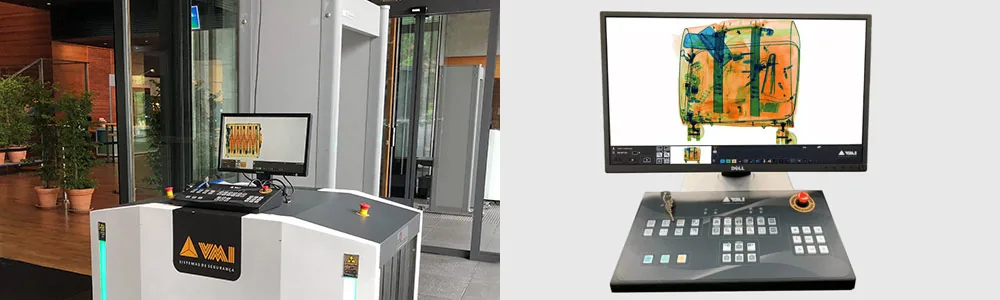
Garrett CMA interface module. For central monitoring of several checkpoints over Ethernet or Wi-Fi, with logging of throughput and alarms, and it can be coupled with a VMI X-ray device.
To the Garrett CMA Wireless interface module
Garrett Super Scanner V. The hand detector for the follow-up check, in professional use for more than 20 years, with high sensitivity to weapons and both acoustic and visual alarm.
To the Garrett Super Scanner V
Our references show a selection of the events we have supported with our security technology.
More articles
Mini Cellphones in Prisons
When 6.35 centimetres undermine prison security. And what helps against it.
Temperature Screening with a Walk-Through Detector
Temperature screening in the walk-through detector. How an add-on module extends entry control by one dimension.
How do access controls deliver the highest security?
Access controls secure buildings, zones or sites. Entry by RFID or card, chip, numeric code, QR code, app and facial recognition. Access controls govern entry through a defined set of rules. The principle is always who, when, where. Only authorised people gain access to the areas cleared for them.
Call us directly
or send us your enquiry.
Free and without obligation. We advise on the right technology for your use case.
Monday to Friday, 8 am to 5 pm. Replies to enquiries within 24 hours.