Temperature Screening with a Walk-Through Detector
A visitor walks through the metal detector, the weapons check runs, and at the same time their body temperature is measured without contact. No second checkpoint, no extra staff, no backlog. What sounds like a thing of the future has long been reality with the Garrett SmartScan.
The pandemic changed a great deal. One awareness has remained. Crowds and infection risks belong together. Airports, ports and railway stations have screened for elevated body temperatures for years. For courts, event halls, logistics centres or public authorities this was long not an option. The need was there. The implementation was too costly.
Contactless temperature measurement with a forehead thermometer ties up a member of staff. They measure every single visitor, keep a minimum distance and react to anything unusual. At a hundred visitors an hour this is feasible. At a thousand it becomes a bottleneck. At five thousand, a stadium, a trade fair, a major event, it is simply no longer workable. The entire entry process would grind to a halt.
The question then suggests itself. Every visitor has to pass through a walk-through detector anyway. Why not use that moment for the temperature measurement?
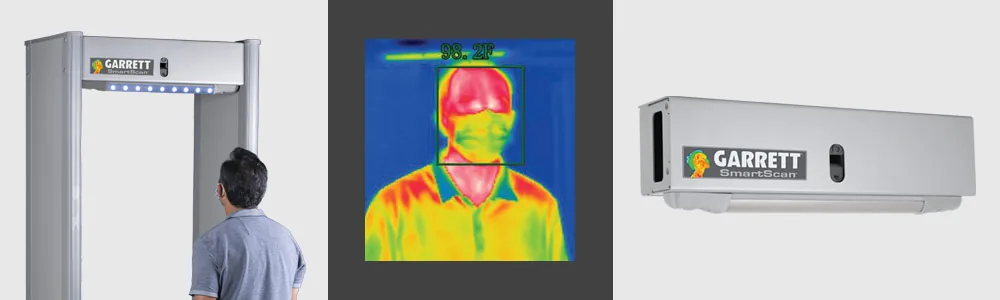
One module, two functions, no extra step
That is exactly the idea behind the Garrett SmartScan. The module sits as an attachment on the archway of an existing Garrett walk-through detector. Specifically, it fits the PD 6500i or the MZ 6100. When a person passes the detector, the SmartScan module captures their body temperature with an infrared sensor. The process happens without contact. It takes the same amount of time as the metal analysis. There is no second stop, no second station, no second member of staff.
The feedback runs through a simple traffic-light system. It shows "go on" or "stop". The signal goes to the person passing through and to the operator at the same time. Anyone who is inconspicuous notices practically nothing of the temperature screening. That is precisely the intention. Discretion is one of the core requirements. This holds true above all in public authorities and at public events. No one there wants to be seen as potentially ill in front of other visitors.
Retrofit instead of new purchase
In practice one point counts above all. The SmartScan is not a standalone device next to the detector. It is a retrofit module for an existing infrastructure. In Europe a great many facilities already use Garrett walk-through detectors. They add temperature measurement as a function without rebuilding the checkpoint.
The module sits on top of the archway and comes in two widths. Standard passages measure 76.2 cm, barrier-free passages 82.6 cm. A lithium battery pack powers it for around eight hours off the grid. That is enough for a full event day without a power socket. The self-calibration adjusts the readings automatically to the ambient temperature. So there is no need to readjust, neither in summer heat nor in draughty entrance areas.
Temperature measurement and metal detection run either coupled or independently. In a logistics centre, theft protection only matters on the way out. On the way in, the module checks the temperature only in the morning. The metal detection is then set to zero. At the shift change the operator activates both.
Network-capable and centrally controllable
Some facilities operate several checkpoints, for example large public authorities, exhibition grounds or stadiums. Here another aspect counts. The walk-through detectors are network-capable. Via Garrett's iC module, several detectors connect to a central computer over Ethernet or Wi-Fi. From there a security manager monitors the entire entry traffic in real time, including temperature alarms, throughput counts and alarm statistics. The internal data memory logs every setting change and every passage for later analysis.
That sounds like surveillance, but it is mostly logistics. A major event runs twenty entrances at once. If a temperature alarm comes in at gate 14, no one has to send a member of staff over to check first. The manager sees it on the screen.
What the SmartScan can do, and what it cannot
One point occasionally gets lost in the debate around temperature screening. The SmartScan is a technical screening instrument, not a medical diagnostic device. It measures body temperature with an accuracy of ±0.5 °C, optionally ±0.2 °C with a reference temperature source. It reliably detects people with a clearly elevated temperature. It does not make a diagnosis. An elevated temperature can point to an infection. It can also come from physical exertion, warm clothing or a hot coffee shortly before entry.
In practice the SmartScan is a filtering instrument. It identifies people for a closer check. The medical assessment is the job of trained specialists. They decide whether a fever is present and what measures follow. That is exactly how the system is designed. It is the first line of defence. It lets the normal case through quickly and makes the exception visible without burdening the workflow.
In data protection terms, body temperature is health data within the meaning of article 9 of the GDPR, the EU general data protection regulation. Operation therefore needs a sound legal basis. The most privacy-friendly interpretation stores no readings. It only outputs the traffic-light signal, go on or stop.
Anyone who already operates security airlocks basically has the infrastructure for temperature screening in place. Only the final module is missing. André Günther, managing director of DTI Security
Who this is relevant for
The most obvious fields of use already have walk-through detectors in operation. At the same time there is an interest in health screening there. In passenger transport, temperature screening has long been standard, at airports, ferry terminals and coach stations. The SmartScan integrates it into the existing security check. It does not set up an extra process alongside.
In public authorities and courts, entry control has been mandatory since 2017 anyway. This gives rise to an elegant dual use. The existing security airlock gains a health component. No additional bottleneck arises for visitors. The same applies to events, from the stadium through trade fairs to the concert hall. There, throughput and security have to be right at the same time.
And then there are the fields of use that do not come to mind at once. In production plants and logistics centres, hundreds of employees pass through a checkpoint per shift. Here it is not only about infection protection but also about operational continuity. If a shift sees a strikingly high number of temperature alarms, you can react early. That way an entire site does not go down all at once.
Note: The Garrett SmartScan is a technical screening instrument for person screening and not a medical diagnostic device. An elevated body temperature shown by the SmartScan should always be checked and confirmed by qualified specialists with medical equipment. The SmartScan does not replace a medical examination.
More articles
Mini Cellphones in Prisons
When 6.35 centimetres undermine prison security. And what helps against it.
How do access controls deliver the highest security?
Access controls secure buildings, zones or sites. Entry by RFID or card, chip, numeric code, QR code, app and facial recognition. Access controls govern entry through a defined set of rules. The principle is always who, when, where. Only authorised people gain access to the areas cleared for them.
Theft Protection | What can you do about theft in the warehouse?
Theft protection in the warehouse begins at the exit. Metal detectors make the exit check effective and legally sound. In logistics this matters more and more, because goods theft is on the rise. Large stocks of attractive goods tempt more than one employee into theft.
Call us directly
or send us your enquiry.
Free and without obligation. We advise on the right technology for your use case.
Monday to Friday, 8 am to 5 pm. Replies to enquiries within 24 hours.