Theft Protection | What can you do about theft in the warehouse?
Stock loss rarely happens spectacularly. It adds up, parcel by parcel, tool by tool, out of everyday operations. In warehousing and logistics a considerable part of it goes back to internal loss. Attractive goods, high staff turnover and patchy returns processes encourage it. Metal detectors at the staff exits are an effective countermeasure. Before the first device is in place, though, the legal question has to be settled. Checking your own employees interferes with personal rights.
First the legal position: checks require a works agreement
Gate and exit checks concern the order of conduct in the workplace and are subject to co-determination under section 87(1) no. 1 of the German works constitution act (Betriebsverfassungsgesetz, BetrVG). If a system also captures conduct or performance, no. 6 applies. The basis is therefore a works agreement with the works council, not a blanket clause in the employment contract. The Federal Labour Court, Germany's highest labour court, drew the limits in 2014 (ruling of 30 July 2014, case 1 ABR 2/13). Gate checks are accordingly permissible when they are proportionate. In the case decided, checks on around 30 days a year were enough, with a random generator selecting the people to be checked. Full checks of all employees are thus neither necessary nor permissible, and physical coercion is not permissible in any case.
In practice this means random sampling instead of a seamless search. Add to that clear rules in the works agreement and a sound data protection basis under article 6 of the GDPR, the EU general data protection regulation. Cause-based checks on a concrete suspicion of theft follow section 26(1) sentence 2 of the German federal data protection act (Bundesdatenschutzgesetz, BDSG) and require a documented suspicion. An advantage of detector technology lies exactly here. A walk-through detector only reports metal. It stores no biometrics and produces no image. Operated without logging the individual, it is the most privacy-friendly solution, an argument that often tips the balance in the works council. Section 87 BetrVG, full text.
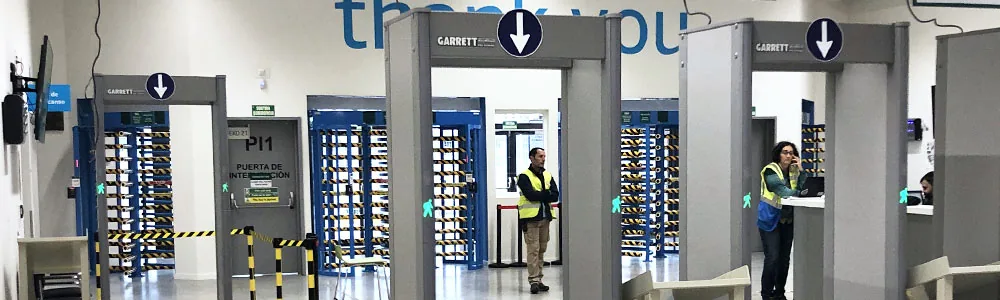
Preparation and supporting measures
Trained security staff keep an eye on unusual behaviour and apply the check within the agreed rules. People with a defibrillator or pacemaker should show their device card and can request a hand check. A walk-through detector is considered safe when you walk through at a steady pace. Technology alone does not reduce the loss. Anyone who creates transparent returns processes, clear guidelines and fair working conditions closes the organisational gaps from which opportunistic theft arises.
Exit check and bag contents
At the staff exit, employees place bags, rucksacks and larger objects on a check table. Metal objects such as a phone or a bunch of keys go into a tray. Only then do they pass the detector frame. Sliding tables or roller tables with a bin keep the process moving. Where staff carry hand luggage, an X-ray baggage scanner increases security. It makes the contents visible without every bag having to be opened.
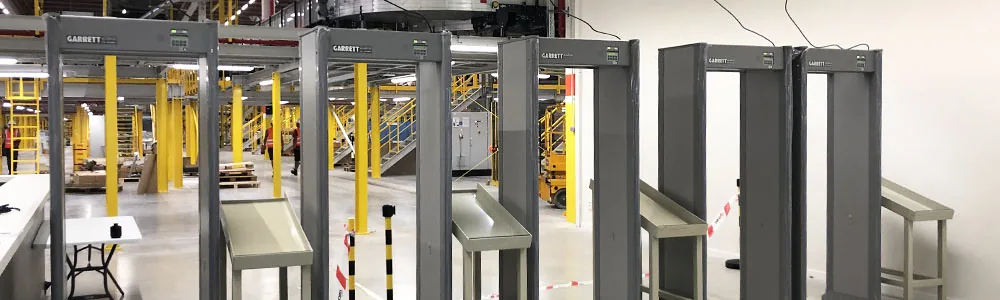
Keeping an overview: counting people
The people counter of the walk-through detector shows how many people are in the area and can be set to the counting direction. FORWARD ONLY counts only passages in the forward direction, REVERSE ONLY only in the opposite direction, and the subtraction mode offsets both directions against each other. In large warehouses, throughput of people is what matters. It has to stay stable even at peak times, without the check becoming a bottleneck.
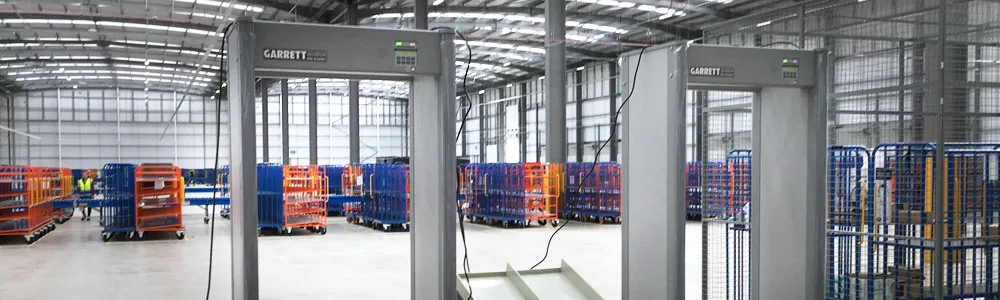
Theft-protection programmes instead of constant false alarms
The right choice of programme is decisive for operation. The walk-through detector can be set to the metals that matter in the particular warehouse. The theft-protection programmes range from highly conductive metals such as jewellery, computer components and coins to magnetic, iron-bearing tools. Higher levels increasingly detect steel tools, but they lower throughput. Everyday items such as cigarette or chewing-gum foil can be masked out on purpose. This keeps the false-alarm rate low and the check flowing. In case of doubt, the follow-up check with the hand detector brings final clarity.
Controlling several sites centrally
The walk-through detectors are network-capable. Via the Garrett iC module, single or many devices connect to a computer over Ethernet or Wi-Fi. This lets you monitor and document passages, alarms and settings centrally. The internal data memory logs setting changes and passage traffic for evaluation. The control unit can be coupled with a VMI X-ray scanner.
The traffic-light system sets the pace
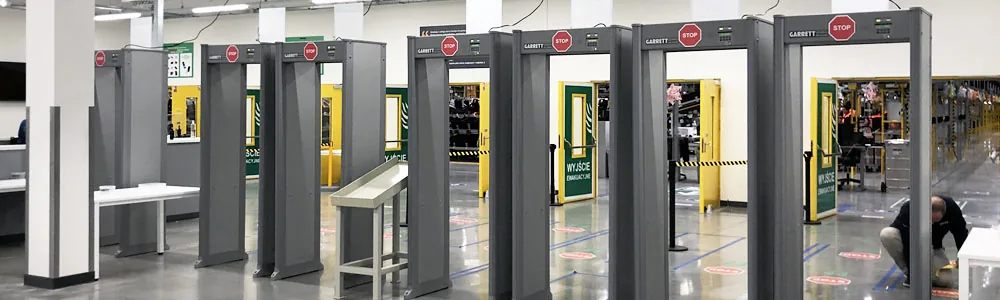
A traffic-light system sets the checking speed. The go and wait symbols only clear the next passage once the previous check is complete. The detection speed can be set to slow, normal or fast, and marked distance lines in front of the frame order the approach.
Video surveillance: openly, never covertly
Video surveillance complements the access control, but it has to be open and signposted. Covert surveillance is not permitted apart from narrowly limited exceptions on a concrete suspicion. The visible presence alone has a preventive effect and documents events for an emergency.
Practical example: theft protection
Customer Amazon
Theft protection at the exit check in the logistics operation.
The requirement for DTI
Reliable checking of employees on the way out, without slowing the shift change.
The solution
A walk-through detector with a sliding table for bag contents, complemented by the manual check by security staff. Final certainty comes from a look inside the bag.
Suitable devices for theft protection
Garrett PD 6500i Dual Optics. The microprocessor-controlled walk-through detector with pinpoint technology locates metal precisely, tells ferrous from non-ferrous metal and detects precious metals. It keeps its settings even without power, needs no calibration after switching on and comes with a people counter. The IP65 version is weatherproof and can also be used outdoors, movable by one person on castors.
To the Garrett PD 6500i Dual Optics
To the Garrett PD 6500i IP65
Garrett SmartScan. The archway attachment measures body temperature without contact during the regular check, with no extra stop. This turns the checkpoint into a multifunctional station.
VMI Spectrum 6040 X-ray scanner. For sites where staff carry hand luggage. The scanner gives the operator a view into bags and luggage on the monitor. It separates materials by colour coding, organic substances in orange, metal in blue. Its 160 kV generator delivers the image quality needed for this. The precise follow-up check is handled by the Garrett Super Scanner V hand-held metal detector.
Our references show a selection of the deployments we have supported with our security technology.
More articles
Mini Cellphones in Prisons
When 6.35 centimetres undermine prison security. And what helps against it.
Temperature Screening with a Walk-Through Detector
Temperature screening in the walk-through detector. How an add-on module extends entry control by one dimension.
How do access controls deliver the highest security?
Access controls secure buildings, zones or sites. Entry by RFID or card, chip, numeric code, QR code, app and facial recognition. Access controls govern entry through a defined set of rules. The principle is always who, when, where. Only authorised people gain access to the areas cleared for them.
Call us directly
or send us your enquiry.
Free and without obligation. We advise on the right technology for your use case.
Monday to Friday, 8 am to 5 pm. Replies to enquiries within 24 hours.