How do entry controls raise security at court?
Since 2017, entry control has been mandatory at German courts.
At local courts, regional courts and in many public authorities, the entrance check looks at whether visitors carry stabbing, striking, cutting or firearm weapons. The task sounds simple, the implementation is not. Entry should be secure. Even so, it must not bring the flow of visitors to a standstill. The walk-through detector, the X-ray scanner and the hand detector work together for this.
Mandatory since April 2017
Since April 2017 a resolution has required every criminal and civil court to have a security concept with metal detectors, baggage scanners, video technology and trained staff. Access is now only through one controlled entrance. Court-internal areas such as judges' chambers are separated from the public rooms. The then Hamburg justice senator Till Steffen summed up the aim. They want to know who is in the building. And they want to make sure that no dangerous objects reach the court.
Preparation and process
The check takes place at the main entrance. Visitors place bags and larger objects on the check table. Metal parts such as a phone or keys go into a tray. Only then do they pass the detector frame. Anyone who follows the instructions gets through quickly. People with a defibrillator or pacemaker should show their device card and can request a hand check. Walking through at a steady pace is considered safe. Fixed consultation hours and appointment scheduling ease the rush further.
Some visitor groups can be sped up in advance:
- Lawyers and members of the police, the public order office, the juvenile court and probation services keep their service ID ready.
- Returning visitors are cleared by card, PIN, RFID or QR code.
- Insolvency administrators and receivers, professional guardians and estate administrators show their appointment order or hearing summons with a photo ID.
- Press representatives keep their press ID with photo ready.
Counting visitors and managing occupancy
If a maximum number of people applies, the people counter of the walk-through detector helps. It can be set to the counting direction, forward only, reverse only or as a subtraction of both directions. This makes it readable at any time how many people are in the building. When someone leaves the building, the next entry becomes free. What matters is that throughput stays stable even at peak times.
Combination with electronic access control
Sensitive areas can additionally be secured electronically. By card, PIN, RFID, QR code or fingerprint, only those who are authorised gain entry. The system records who entered which area and when. Single doors are often retrofitted with standalone solutions, while larger buildings are controlled centrally through networked online systems.
Adapted to the architecture
Court buildings are often architecturally demanding and have narrow entrances. Walk-through detectors in an understated design stay unobtrusive there. They can be positioned so that a single member of the checking staff keeps the station in view. From walk-through detector, X-ray scanner and hand detector we assemble the airlock to suit the premises.
What the detector finds
For entry control, programmes such as court, building or the alternative programme, which is recommended under difficult electrical conditions, are suitable. They reliably detect firearms, ammunition, striking and stabbing weapons, knives, scissors or pepper spray. They filter out harmless pocket items so that throughput stays high. The security staff keep items classed as dangerous.
Ban on photography and filming
In court buildings, photography and filming are prohibited as a rule. Cameras and other audio or video recording devices do not belong in hand luggage. Dictation devices of officials and of lawyers are exempt, and in individual cases written permission can be requested in advance.
X-ray operation: the operator obligations
Anyone who uses a baggage scanner at court operates an X-ray device, and that is tied to clear obligations. As a type-approved fully shielded device, the scanner is subject to notification under the German radiation protection act (Strahlenschutzgesetz, StrlSchG). You register it with the responsible state authority at least two weeks before commissioning. These devices usually do not require a dedicated radiation protection officer (section 19(3) StrlSchG), which keeps the operator's effort low. The radiation stays inside the shielded housing, and the statutory limit is 3 µSv/h at 0.1 m distance. Before the first commissioning and at least every five years afterwards, an officially appointed expert inspects the device. We accompany the notification, the instruction of staff and the inspection appointments. Section 19 StrlSchG, full text.
Suitable devices for entry control
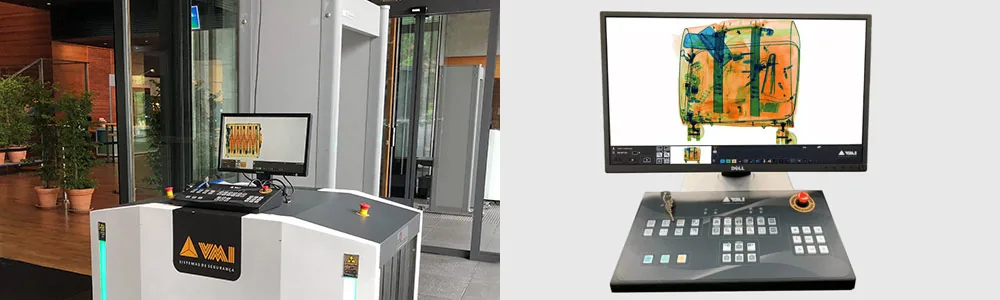
VMI Spectrum 6040 X-ray scanner. For checkpoints with a lot of hand luggage. The scanner gives the operator a view into bags and luggage on the monitor, and its 160 kV generator delivers the image quality needed. It is network-capable and can be coupled with a walk-through detector, so the entry can be overseen on one screen.
Garrett PD 6500i Dual Optics. The microprocessor-controlled walk-through detector with pinpoint technology locates metal precisely, tells ferrous from non-ferrous metal and detects precious metals. It keeps its settings without power, needs no calibration after switching on and comes with a people counter. The IP65 version is weatherproof, movable by one person on castors.
To the Garrett PD 6500i Dual Optics
To the Garrett PD 6500i IP65
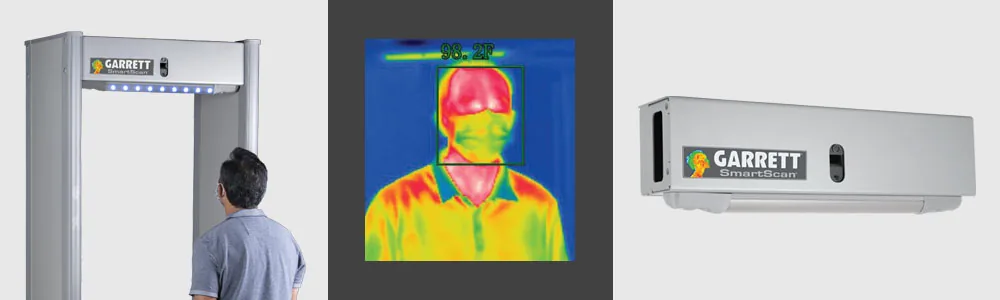
Garrett SmartScan. The archway attachment measures body temperature without contact during the regular check, with no extra stop and without a fuss.
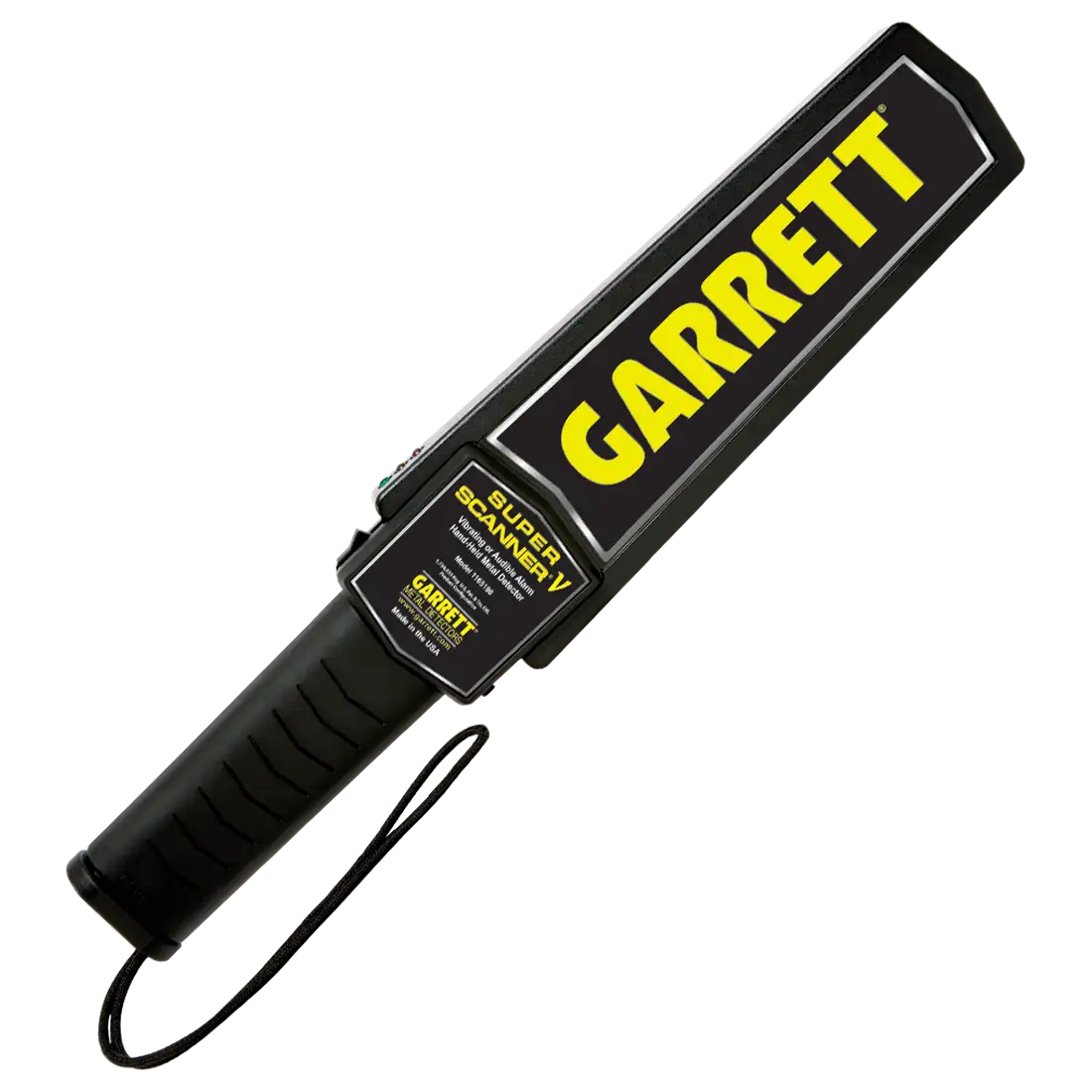
Garrett Super Scanner V. The hand detector for the follow-up check, in professional use for more than 20 years. It detects even the smallest metal objects, works after switching on without any further setting and signals finds acoustically and visually. An elimination switch masks out interfering ambient metal such as floor reinforcement.
To the Garrett Super Scanner V
Our references show a selection of the deployments we have supported with our security technology.
More articles
Mini Cellphones in Prisons
When 6.35 centimetres undermine prison security. And what helps against it.
Temperature Screening with a Walk-Through Detector
Temperature screening in the walk-through detector. How an add-on module extends entry control by one dimension.
How do access controls deliver the highest security?
Access controls secure buildings, zones or sites. Entry by RFID or card, chip, numeric code, QR code, app and facial recognition. Access controls govern entry through a defined set of rules. The principle is always who, when, where. Only authorised people gain access to the areas cleared for them.
Call us directly
or send us your enquiry.
Free and without obligation. We advise on the right technology for your use case.
Monday to Friday, 8 am to 5 pm. Replies to enquiries within 24 hours.