Planning Major Events with Security Screening
Security at major events begins at the entrance.
Whether a festival becomes a major event is decided not by gut feeling but by the number of visitors and the level of risk. As the number of people grows, so does the responsibility towards visitors, operator and staff. Entry is the point where security can be established most effectively. Whoever intercepts dangerous objects or risk individuals here no longer has to look for them inside.
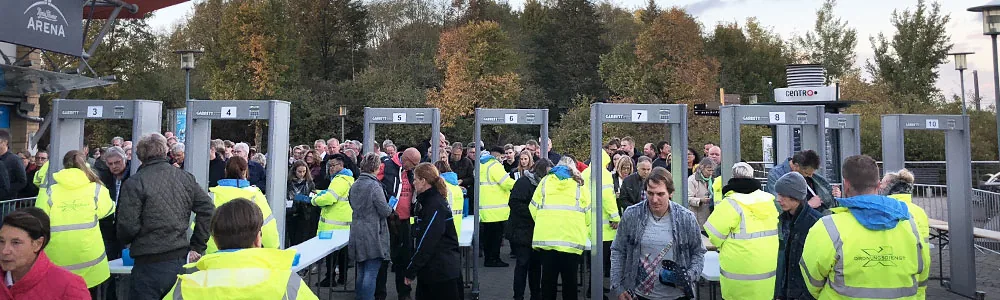
When does it count as a major event?
There is no fixed threshold. Administrative practice counts an event as one from around 100,000 visitors. This also applies when the expected number of visitors at a municipal festival exceeds one third of the residents. It likewise counts as one as soon as at least 5,000 people are on the site at the same time. The individual case is what decides. A security concept has to be drawn up as soon as a level of risk exists. In the city it is usually higher than in the countryside. Bring the responsible municipality into the planning early.
Registration and permit
Public events need the municipality's permit, and registration is with the public order office. It covers the location and type of premises, the serving of drinks and the occasion and duration. If the event lasts longer than four days, the hospitality licensing authority is responsible. From around 400 participants the fire brigade is involved. For third-party music, fees to GEMA, the German performing-rights organisation, apply. The statutory accident insurance institution (Berufsgenossenschaft) clarifies the insurance cover. The police, fire brigade and ambulance service belong in the planning. Factor in the permit deadlines early.
Counting visitors
The people counter of the walk-through detector shows how many people are on the site. Together with the ticketing system you keep an eye on occupancy. Whether re-entry is possible and whether the site is divided decides the choice of ticket type. The visitor profile also stays important. Which target group does the staff have to prepare for?
Placement and visitor flows
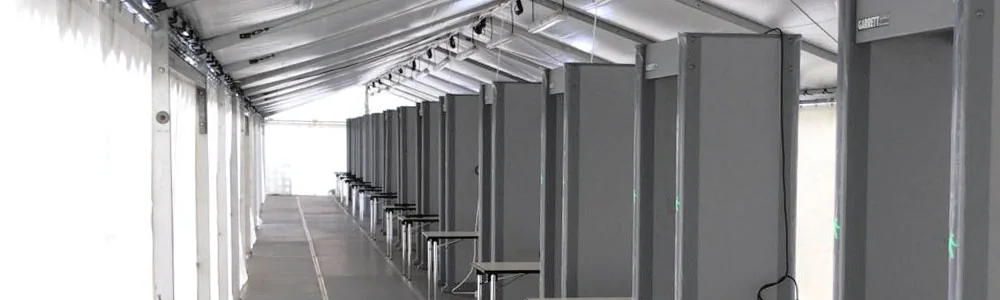
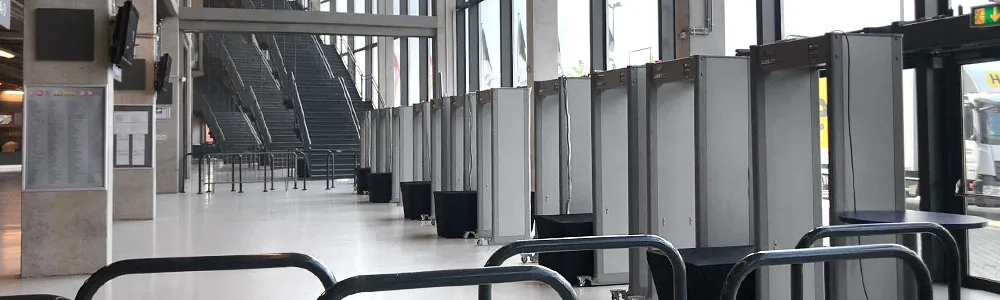
The walk-through detectors stand on level, stable ground, protected from rain and condensation, often in a tent set up in front. Plan additional archways where visitors build up at certain times. Crowd management guides the flows, for example at narrow points or towards particular areas. It thrives on calm, overview and information. The staff know the escape and rescue routes and stay informed about the current status. That way everyone can react at the same time in an emergency.
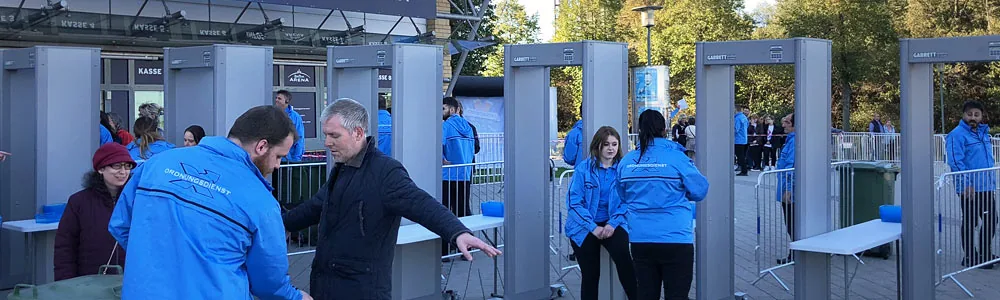
What the detector finds
Preset programmes such as spectator, building or airport detect firearms, ammunition, striking and stabbing weapons, knives or pepper spray. They filter out harmless items such as coins, keys or foils. This keeps weapon detection accurate at high throughput, without blocking entry with false alarms.
The traffic-light system sets the pace
With the go and wait symbols, the detector controls the checking speed. The light only turns green once the previous check is complete. In this way it keeps the flow even under intermittent pressure. The detection speed can be set to slow, normal or fast, and distance lines in front of the frame order the approach.
Qualified security staff
Safe checks require experienced staff with a feel for people, who spot intoxicated individuals, aggressive groups or suspicious behaviour early. For most guarding activities the 40-hour instruction at the IHK, the German chamber of industry and commerce, is enough (section 34a(1a) of the German trade regulation act (Gewerbeordnung, GewO), section 6 of the German guarding ordinance (Bewachungsverordnung, BewachV)). For certain tasks, such as running entry in a leading role at access-controlled major events, the IHK expert examination is mandatory. Since 2019 every guard has to be entered in the German guard register (Bewacherregister) before deployment (section 11b GewO). They wear a visible badge with a name or ID number and the name of the company.
Central monitoring and networking
All threads come together at a central point. Organiser, administration, police, fire brigade, ambulance service and security staff have to be reachable at all times, and a stable radio connection ensures that. Cameras at critical points, signal technology for wayfinding and loudspeakers for addressing the crowd complement the communication. The walk-through detectors are network-capable. Via the iC module, passages and alarms can be monitored and documented centrally over Ethernet or Wi-Fi.
Practical example: Arena Oberhausen
The requirement for DTI
An additional person check for firearm, stabbing and cutting weapons in the entrance area.
The solution
In front of the turnstiles, a security airlock of mobile walk-through detectors and manual access control by security staff. Final certainty comes from the follow-up check with the hand detector.
Suitable devices for your event
Garrett PD 6500i Dual Optics. The microprocessor-controlled walk-through detector with pinpoint technology is designed for high throughput of people, tells ferrous from non-ferrous metal and detects precious metals. It keeps its settings without power and comes with a people counter. The IP65 version is weatherproof and can be moved by one person on castors, so it can also be used outdoors.
To the Garrett PD 6500i Dual Optics
To the Garrett PD 6500i IP65
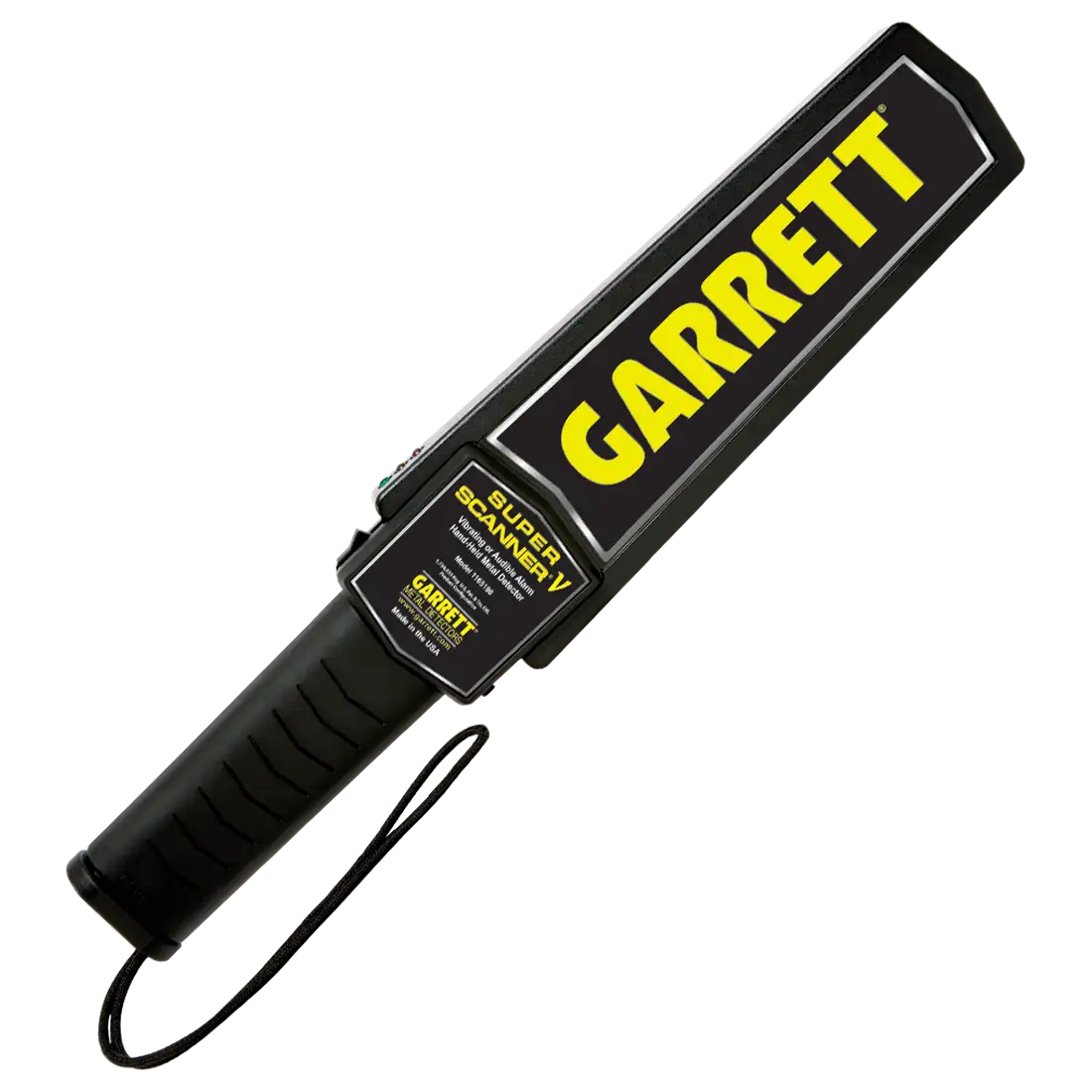
Garrett Super Scanner V. The hand detector for the follow-up check, in professional use for more than 20 years, with high sensitivity to weapons, automatic calibration and both acoustic and visual alarm.
To the Garrett Super Scanner V
Our references show a selection of the major events we have supported with our security technology.
More articles
Mini Cellphones in Prisons
When 6.35 centimetres undermine prison security. And what helps against it.
Temperature Screening with a Walk-Through Detector
Temperature screening in the walk-through detector. How an add-on module extends entry control by one dimension.
How do access controls deliver the highest security?
Access controls secure buildings, zones or sites. Entry by RFID or card, chip, numeric code, QR code, app and facial recognition. Access controls govern entry through a defined set of rules. The principle is always who, when, where. Only authorised people gain access to the areas cleared for them.
Call us directly
or send us your enquiry.
Free and without obligation. We advise on the right technology for your use case.
Monday to Friday, 8 am to 5 pm. Replies to enquiries within 24 hours.